Galapagos and the Quito Highlands
Eight days: two in Quito's colonial centre at 2,850 metres, then six across three islands on the equator.
Polar & Wild · 8 days · Jan, Feb, Mar, Jun, Jul, Aug, Dec
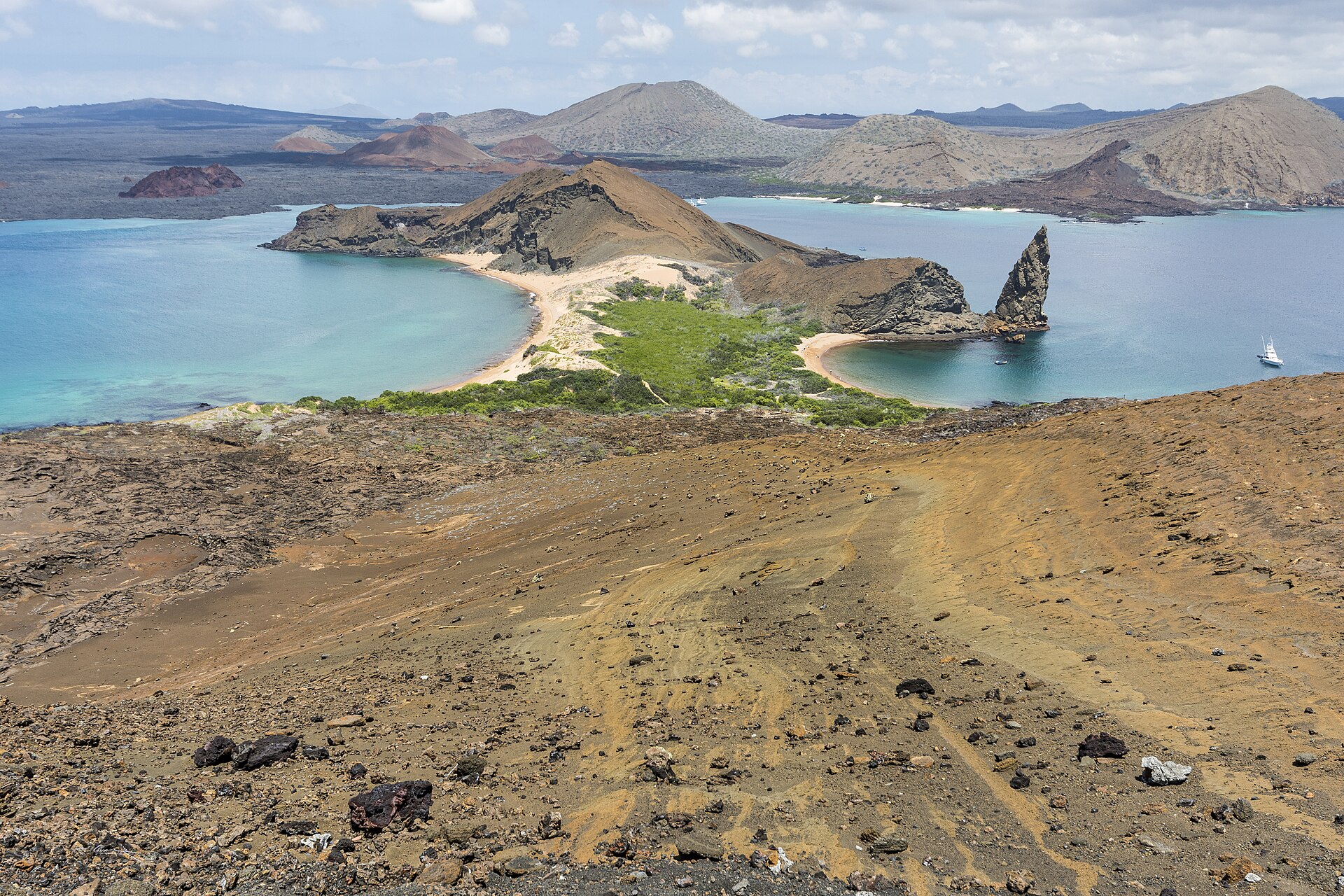
Almost every Galapagos trip treats Quito as an airport, which wastes the best-preserved colonial centre in the Americas and skips the acclimatisation the highlands quietly provide. Two days in the city and one at Cotopaxi, then the flight west. On the islands the choice that matters is land-based versus live-aboard: this is land-based across Santa Cruz and Isabela, which costs you the northern islands but gives you Sierra Negra, the tortoise reserve and the freedom to swim twice a day rather than on a schedule. Every landing site is guided by law and the naturalist is not optional.
Day by day
- Day 1
Quito's old town
Arrive, go slowly at 2,850 metres, and walk the centre before the afternoon rain.
14:00Plaza Grande and the Palacio de Carondelet
Quito was the first city inscribed on the World Heritage list, on the grounds of having the least-altered colonial centre in Latin America.
Rain arrives most afternoons and stops as quickly. Altitude here is real; walk uphill slowly on the first day.
16:00Iglesia de la Compania de Jesus
160 years to build and the entire interior covered in gold leaf, with a Moorish-influenced ceiling that is unlike any other church on the continent.
No photography inside. Closes earlier on Sundays.
- Day 2
Cotopaxi
Two hours south to a 5,900-metre volcano, and a genuine acclimatisation day before the flight.
08:00Cotopaxi National Park and the Jose Rivas refuge
One of the highest active volcanoes in the world, and the walk up to the refuge is the only place most people will ever stand at nearly 5,000 metres.
The car park is at 4,600 metres and the refuge at 4,864. That is a hard hour on loose ash. The park closes at short notice on volcanic activity.
14:30Laguna de Limpiopungo
Wild horses and Andean lapwings on a paramo lake, and the classic view of Cotopaxi that the mountain only grants for about an hour a day.
Flat walking at 3,800 metres, with the cone behind the water if the cloud lifts.
- Day 3
West to Santa Cruz
The morning flight, the Baltra crossing, and the highlands on the way down to town.
13:00El Chato tortoise reserve
Wild giant tortoises in the wet highland pasture they migrate to, rather than in a pen: the largest of them are well over a hundred years old.
Wet and muddy in the highlands; boots are provided. Keep two metres from the animals, which is a rule and not a suggestion.
16:00Los Gemelos
Two collapsed magma chambers in a forest of endemic scalesia, which is the closest thing the islands have to a cloud forest and is vanishing fast.
Roadside, with a short loop through the scalesia forest between the two craters.
- Day 4
Santa Cruz
The station in the morning and the best beach in the archipelago in the afternoon.
08:30Charles Darwin Research Station
The breeding programme that has put thousands of tortoises back on islands where they had been eaten out, and the clearest explanation on the islands of what is actually being protected.
A twenty-minute walk from the pier along the shore road. Lonesome George is preserved here in a climate-controlled room.
11:00Tortuga Bay
A kilometre of white sand with marine iguanas piled on the rocks and blacktip sharks patrolling the shallows of the lagoon behind it.
A 2.5 kilometre paved trail from town, and you must sign in and out at the gate. The main beach has a serious current; swim at the sheltered Playa Mansa at the far end.
- Day 5
Across to Isabela
Two hours on the ferry to the largest and youngest island.
14:00Concha de Perla
A sheltered natural pool five minutes from the ferry landing where you can snorkel with turtles and penguins without a boat.
A boardwalk through mangroves from beside the pier. Sea lions sleep on the steps and have right of way.
16:30Centro de Crianza and the flamingo lagoons
Isabela's own tortoise breeding centre, reached along a boardwalk through the largest coastal lagoon system in the islands.
The boardwalk between the town and the centre crosses several brackish lagoons; the flamingos move between them.
- Day 6
Sierra Negra
Up to the second-largest volcanic caldera on earth, on foot.
07:30Sierra Negra and Volcan Chico
A caldera ten kilometres across, and the walk out to Volcan Chico crosses lava flows from the 1979 and 2005 eruptions with Fernandina on the horizon.
Sixteen kilometres return, muddy at the start and exposed lava after. A guide is mandatory. The volcano last erupted in 2018 and access closes without warning.
16:30Playa del Amor and the Muro de las Lagrimas road
A wall of lava blocks built by prisoners in a penal colony in the 1940s for no purpose other than to occupy them; men died building it.
Bicycles can be hired in town; it is about six kilometres each way on flat track.
- Day 7
Los Tuneles
The best snorkelling in the archipelago that you can reach without a live-aboard.
08:00Los Tuneles
Collapsed lava tubes forming arches over clear shallow water, with white-tipped reef sharks resting under the ledges and seahorses in the mangrove roots.
The boat crosses a surf break to get in; it can be cancelled on swell and the crossing is not gentle. Book through a licensed operator only.
16:00Las Tintoreras
A narrow lava channel where reef sharks rest in numbers during the day, and the largest marine iguana colony on the island is on the rocks beside it.
A short boat ride from the pier and a guided walk over sharp lava; proper shoes matter.
- Day 8
Back to the mainland
The early ferry, the Baltra flight, and a last afternoon in Quito.
06:00Ferry to Santa Cruz and the Baltra crossing
The crossing back is genuinely long, and treating it as a travel morning rather than an errand is the difference between a calm departure and a missed flight.
Two hours in an open speedboat, then a bus, a channel ferry and another bus. Allow the whole morning and do not book a tight connection.
18:00Mercado Central, Quito
A last hour of the mainland: hornado, locro and around thirty varieties of fruit that do not leave the country.
Closes early evening; the fruit-juice counters at the front are the reliable thing.
Questions
- How long is the Galapagos and the Quito Highlands itinerary?
- The Galapagos and the Quito Highlands itinerary runs 8 days and covers 16 stops across Quito, Puerto Ayora, Puerto Villamil.
- When is the best time to do the Galapagos and the Quito Highlands itinerary?
- Jan, Feb, Mar, Jun, Jul, Aug, Dec is the best window for the Galapagos and the Quito Highlands itinerary.
- What happens on day one of the Galapagos and the Quito Highlands itinerary?
- Day one is quito's old town: Arrive, go slowly at 2,850 metres, and walk the centre before the afternoon rain.
Sources
Save this itinerary to CarryOn and it becomes a real trip — every stop on your timeline, with entry requirements checked against your passport and the whole thing editable.
Save this as a tripCurated by CarryOn