Luxor and Aswan by Nile
The night train south, then Karnak at opening and Abu Simbel after the coaches.
Ancient Wonders · 7 days · November to March
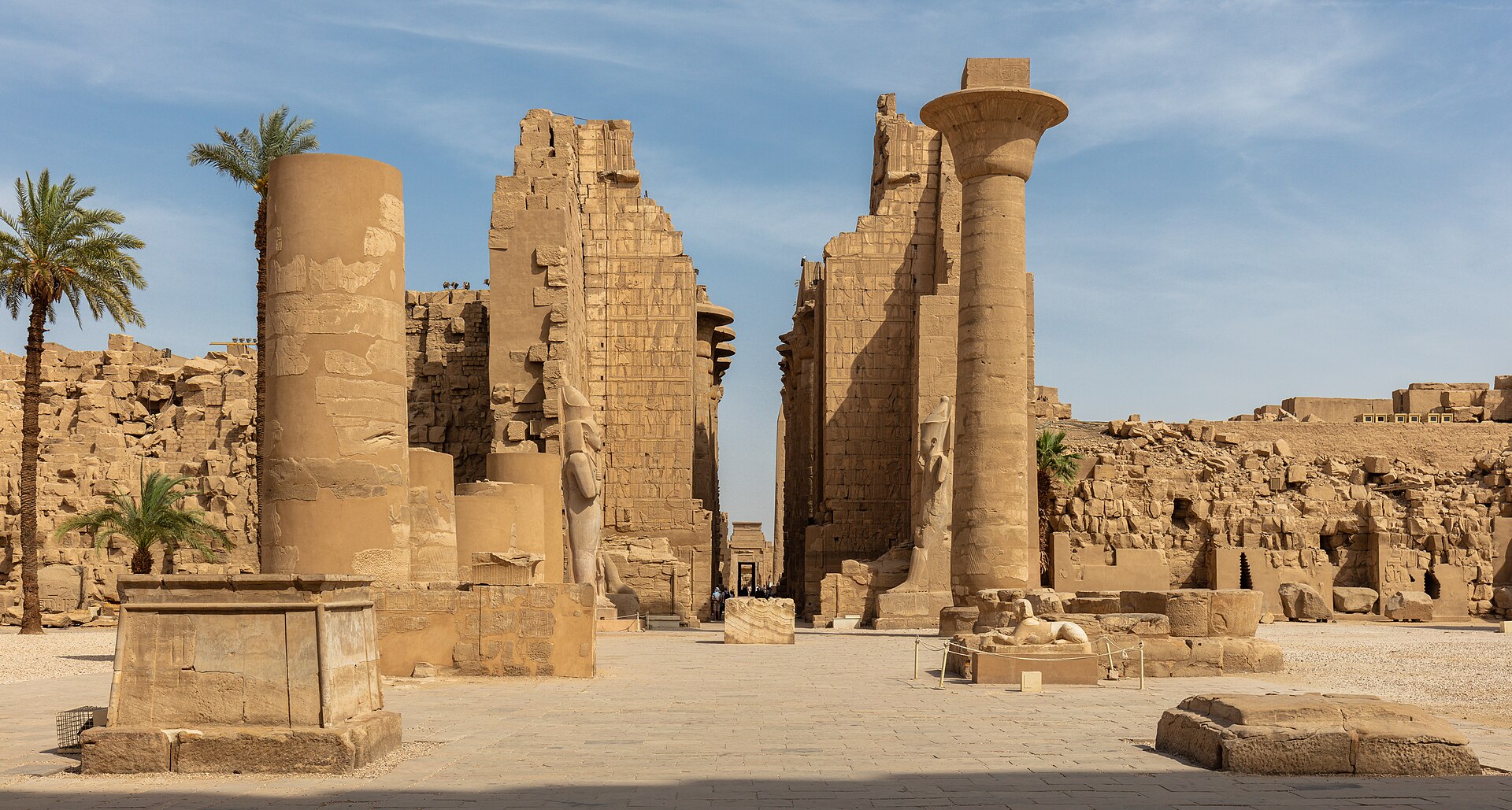
Take the sleeper from Giza rather than the morning flight. It costs you nothing in daylight and it puts you at the Karnak gate at six, which is the whole trick — ninety minutes in the Hypostyle Hall before the first coach turns in. Working upstream also means the sites get quieter as you go: Dendera and Medinet Habu are near-empty next to the Valley of the Kings, and Abu Simbel at ten in the morning is a different place from Abu Simbel at six. Book the Old Cataract knowing Mandarin Oriental took over the management in 2026 and only the historic wing is currently open.
Day by day
- Day 1
Giza, then the sleeper
The new museum in the morning, the plateau in afternoon light, the night train south.
09:00Grand Egyptian Museum
The complete Tutankhamun assemblage is shown together here for the first time since Carter lifted it, and the atrium window frames the pyramids two kilometres away.
Fully opened in November 2025 after two decades of construction — allow four hours minimum, and the Grand Staircase alone takes one.
15:00Great Pyramid and the Sphinx
Late afternoon flattens the heat and the light, and the plateau empties from about four — the Sphinx enclosure is a different place once the morning buses have gone.
Entry into the Great Pyramid's interior needs a separate ticket sold at the plateau gate in limited daily numbers; it goes by mid-morning.
- Day 2
Karnak before the coaches
Off the train and straight through the gate at opening; the east bank's second temple after dark.
06:00Karnak Temple
Two thousand years of pharaohs each added a wing, so this is less a temple than an argument between dynasties that you walk through.
Gates open at 06:00 and the coach groups arrive from about 08:30 — the Hypostyle Hall is a genuinely different room before then.
18:30Luxor Temple
A working sacred site continuously for 3,400 years: Roman fresco over pharaonic relief, and a thirteenth-century mosque still in use built halfway up the ancient courtyard wall.
Open into the evening and floodlit — the one major Egyptian site that is better after dark than before it.
- Day 3
The west bank in one long morning
Tombs first while it is cool, then two temples the crowds skip, and back before the worst heat.
06:30Valley of the Kings
Sixty-three tombs cut into a valley chosen because the peak above it is a natural pyramid — and the painted ceilings in the deeper shafts have never been restored, only cleaned.
The standard ticket admits you to three tombs from a rotating open set; Seti I, Nefertari and Tutankhamun each cost extra and Seti I is the one worth it.
09:45Temple of Hatshepsut
Three colonnaded terraces driven into a 300-metre cliff, and the Punt reliefs on the middle level are the earliest detailed record of an Egyptian trading voyage.
There is no shade anywhere on the terraces and the limestone reflects the heat straight back at you.
11:45Medinet Habu
Ramesses III's mortuary temple keeps more original paint than anything else on the west bank, and because the coaches do not stop here you will often have the second court to yourself.
- Day 4
North to Dendera
Ninety minutes up the valley for the best-preserved ceiling in Egypt, and back by mid-afternoon.
08:00Dendera Temple
Centuries of soot were cleaned off the astronomical ceiling in the 2000s and what came out from under it is the original Ptolemaic paint — deep blue, unrestored, and unlike anything else you will see this week.
About ninety minutes north of Luxor by road; the crypts under the hypostyle hall are entered by a narrow stair and are worth the squeeze.
- Day 5
Upstream to Edfu and Kom Ombo
The road down the east bank with two temples on it, arriving Aswan for dinner.
08:30Temple of Horus at Edfu
Buried in sand until the 1860s, which is why it is the most completely preserved temple in Egypt — roof on, doors in place, and the founding rituals still legible on the walls.
The cruise boats disgorge here from about 09:30 in a single wave; arriving on the road half an hour earlier means an empty pronaos.
16:00Temple of Kom Ombo
A double temple built in perfect mirror image for two gods at once, standing right on the riverbank — and at dusk the cruisers have moved on and it is lit and empty.
The crocodile museum next door holds around three hundred mummified crocodiles and is included in the ticket.
- Day 6
Aswan
An island temple in the morning, the granite quarries, and the museum that explains the dam.
08:00Philae Temple
The last functioning temple of the ancient Egyptian religion, closed by Justinian in the sixth century — then cut into 40,000 blocks and moved to a higher island when the High Dam drowned the original one.
Reached only by motorboat from Marina Philae; agree the return fare and the waiting time with the boatman before you step off.
11:00Unfinished Obelisk
Forty-two metres of granite still attached to the bedrock, abandoned when it cracked — it shows you exactly how the obelisks in Rome and Paris were cut, which no finished one can.
16:00Nubian Museum
Built with UNESCO money to hold what was salvaged before Lake Nasser rose, it is the only place that tells you honestly what the High Dam cost and whose villages went under it.
- Day 7
Abu Simbel
Three hours south across the desert, deliberately late, and out from Aswan.
10:00Abu Simbel Temples
Ramesses II cut four twenty-metre versions of himself into a cliff to be seen by anyone coming north out of Nubia — and in the 1960s the whole mountain was sawn up and rebuilt sixty-five metres higher, which is arguably the more astonishing feat.
The coach fleet leaves Aswan around 04:00 and has cleared out by mid-morning; a later start gives you the facade almost alone. Photography inside is restricted.
Questions
- How long is the Luxor and Aswan by Nile itinerary?
- The Luxor and Aswan by Nile itinerary runs 7 days and covers 14 stops across Cairo, Luxor, Edfu, Kom Ombo, Aswan.
- When is the best time to do the Luxor and Aswan by Nile itinerary?
- November to March is the best window for the Luxor and Aswan by Nile itinerary.
- What happens on day one of the Luxor and Aswan by Nile itinerary?
- Day one is giza, then the sleeper: The new museum in the morning, the plateau in afternoon light, the night train south.
Sources
Save this itinerary to CarryOn and it becomes a real trip — every stop on your timeline, with entry requirements checked against your passport and the whole thing editable.
Save this as a tripCurated by CarryOn