Muscat and the Hajar
Muscat, two mountain plateaux and the Sharqiya dunes in one clockwise loop.
Desert & Dunes · 6 days · November to March
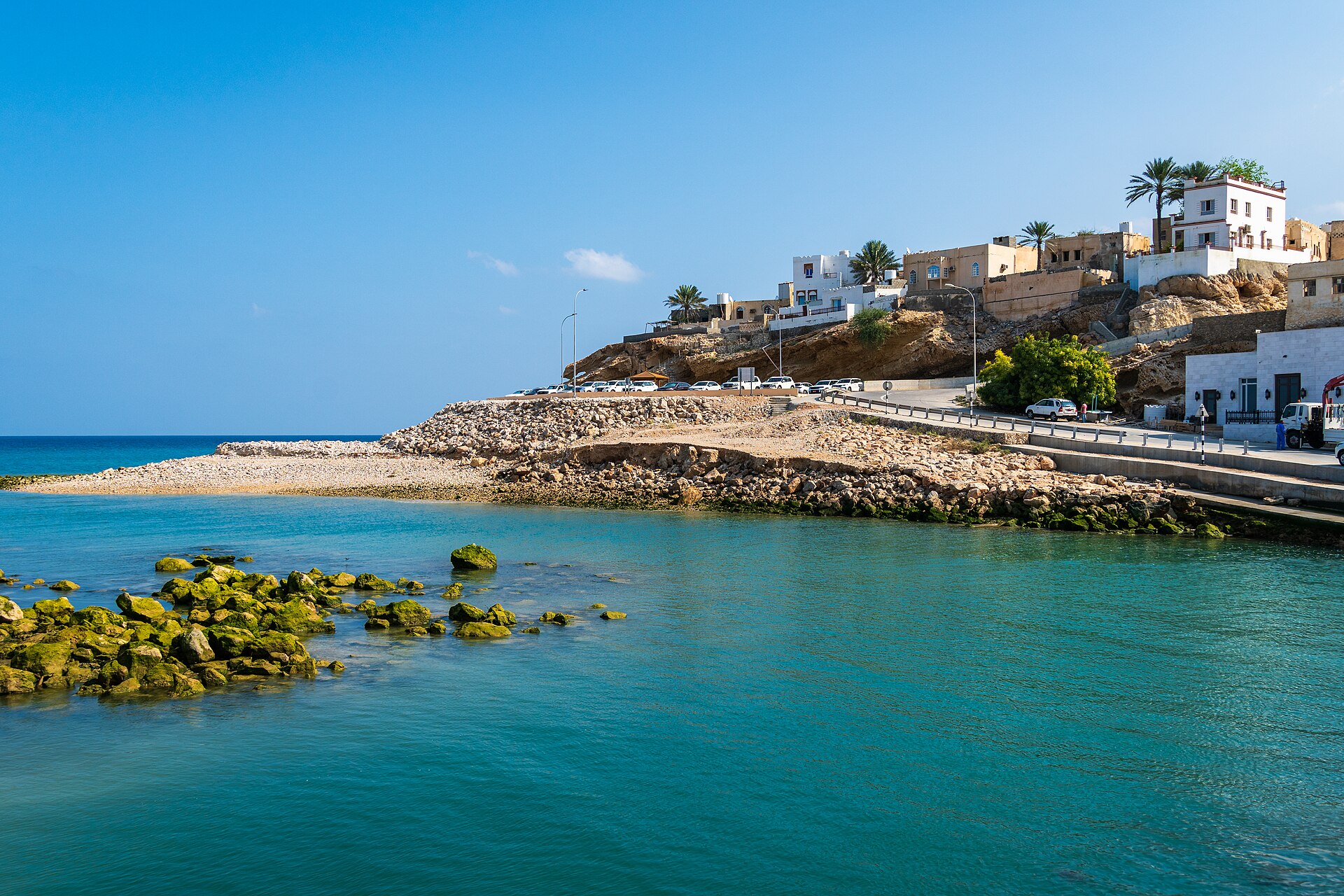
The standard Oman week is Muscat, a night in a desert camp and a day trip to Nizwa. This one puts the mountains at the centre instead: Jebel Akhdar for the terraced villages and the cold nights at 2,000 metres, then Jebel Shams for the Balcony Walk along the canyon wall. The dunes come last, on the way back to the coast, so you reach the sand in the final hours of light rather than at noon when it photographs like concrete. Everything above Birkat Al Mouz needs a 4x4 — the police checkpoint turns saloon cars back, no exceptions.
Day by day
- Day 1
Mosque, then souq
Muscat's two set pieces sit at opposite ends of the city and open at opposite ends of the day, which conveniently makes them a whole day on their own.
08:30Sultan Qaboos Grand Mosque
A single 21-tonne hand-knotted Persian carpet under one chandelier, and a country that lets non-Muslims walk into its main prayer hall — rarer in the Gulf than it ought to be.
Non-Muslim visiting hours are roughly 08:00 to 11:00, Saturday to Thursday. Ankles and wrists covered for everyone; hair covered for women. Scarves are sold at the gate but bring your own.
17:30Mutrah Souq
One of the oldest continuously working markets in Arabia, and the frankincense sellers start burning samples once the evening trade begins.
Shuts for the afternoon and reopens around 16:00. Most of Friday it stays closed until late in the day.
- Day 2
Forts, then the climb
Two fortresses on the plain — one a defensive puzzle, one a mud-brick problem that took decades to solve — before the checkpoint and the road up onto the plateau.
09:00Nizwa Fort
The great drum tower is one long defensive trick — false doors, murder holes, a shaft built for boiling date syrup — and the silver souq next door is still a working one.
The livestock market beside it runs on Friday mornings only, from about 06:30, and it is finished by nine.
11:30Bahla Fort
Mud brick at a scale that has no business standing up — Oman's first UNESCO listing, and it took twenty-four years of work to stop it dissolving.
- Day 3
The Green Mountain
A cold, high day of walnut trees and abandoned stone houses, ending on the falaj terraces that only make sense once you have seen where the water comes from.
08:30Wadi Bani Habib
An abandoned stone village facing a walnut grove across the valley floor, still roofed in places, and empty enough that you hear the irrigation channel running.
About fifteen minutes of stone steps down into the wadi and the same back up in full sun — do it early, not after lunch.
15:30Saiq Plateau terraces
The W18b path links Al Aqr, Ash Shirayjah and Al Ayn along the falaj channel itself, so you walk the water supply that built every terrace you are looking at.
Damask roses flower from late March into mid-April and the village distilleries run then. Outside that window the terraces are pomegranate, apricot and walnut.
- Day 4
The Balcony
Down off one mountain, across to the next, with a village built on bare rock in between and the country's best walk in the afternoon.
09:00Misfat Al Abriyeen
Mud and stone houses stacked on exposed rock above their own date plantation, with the falaj running through the alleys at head height.
Park at the top and walk in — the lanes are too narrow for a vehicle, and the plantation path loops back to the car park.
14:00Balcony Walk, W6
A shepherd's ledge cut halfway down the Wadi Nakhr canyon wall to the abandoned village of As Sab — flat walking with a thousand metres of air beside you.
Orange-and-white paint marks the route; four kilometres out and the same path back. No scrambling, but no railing either, and the drop is constant.
- Day 5
Pools and dunes
The long transit east, broken by the one wadi worth stopping for, then into the sand belt with two hours of good light left.
11:30Wadi Bani Khalid
Year-round turquoise pools in a limestone gorge, and the one place in Oman where a swim is genuinely worth the detour rather than a consolation prize.
Modest swimwear is expected — shoulders and knees covered. Walk fifteen minutes past the first crowded pool and the water clears.
16:00Sharqiya Sands
Arriving in the last two hours of daylight is the difference between orange dunes and grey ones, and the drive in over the belt is half the experience.
Camps meet you at Al Wasil, deflate the tyres and drive you in. Do not take a hire 4x4 onto soft sand without a guide — recovery out here is expensive and slow.
- Day 6
Back along the coast
North out of the sand to the shore road, with a gorge swim and a collapsed limestone pool before the airport.
09:30Wadi Shab
The final pool is inside a cave you swim into through a gap barely wider than your shoulders — the one thing in Oman that no photograph prepares you for.
A boatman ferries you across the inlet for a small fee, then it is about forty minutes of walking and three short swims to reach the waterfall chamber. Dry bag essential.
13:30Bimmah Sinkhole
A collapsed limestone chamber forty metres across, filled with brackish blue-green water that connects to the sea a couple of hundred metres away.
Signposted off the coast highway with a proper car park. Steps go right down to the water, and the small fish will pick at your feet.
Questions
- How long is the Muscat and the Hajar itinerary?
- The Muscat and the Hajar itinerary runs 6 days and covers 12 stops across Muscat, Nizwa, Jebel Akhdar, Jebel Shams, Sharqiya Sands.
- When is the best time to do the Muscat and the Hajar itinerary?
- November to March is the best window for the Muscat and the Hajar itinerary.
- What happens on day one of the Muscat and the Hajar itinerary?
- Day one is mosque, then souq: Muscat's two set pieces sit at opposite ends of the city and open at opposite ends of the day, which conveniently makes them a whole day on their own.
Sources
Save this itinerary to CarryOn and it becomes a real trip — every stop on your timeline, with entry requirements checked against your passport and the whole thing editable.
Save this as a tripCurated by CarryOn