Samarkand and Bukhara
Three Silk Road cities west by high-speed rail, ending inside Khiva's walls.
Ancient Wonders · 7 days · Apr, May, Sep, Oct
Almost everyone lands in Tashkent and works east from Khiva. Going west instead puts the cities in the order they get older, smaller and quieter — Samarkand's imperial scale first, then Bukhara's lived-in lanes, then Khiva, which is compact enough that you can walk out of the gate at dusk and be in the desert. The Afrosiyob does Tashkent to Samarkand in a little over two hours and Samarkand to Bukhara in ninety minutes. Book the seats the day they open; in April and October they are gone weeks ahead.
Day by day
- Day 1
Tashkent, briefly
One market and one square is the right amount of Tashkent — enough to understand why the rest of the trip looks nothing like it.
09:30Chorsu Bazaar
The blue dome is the meat and dairy hall; the things worth carrying home — dried melon, black cumin, old suzani — are in the open rows behind it.
Best before 11:00. The spice and dried-fruit sellers start packing up mid-afternoon.
17:00Amir Timur Square
Tashkent rebuilt itself around this square after the 1966 earthquake, which is why the capital is Soviet and everything else on this trip is not.
- Day 2
Registan day
Samarkand's set piece first thing, a collapsing mosque before lunch, and Timur's own tomb once the evening lights come on.
08:30The Registan
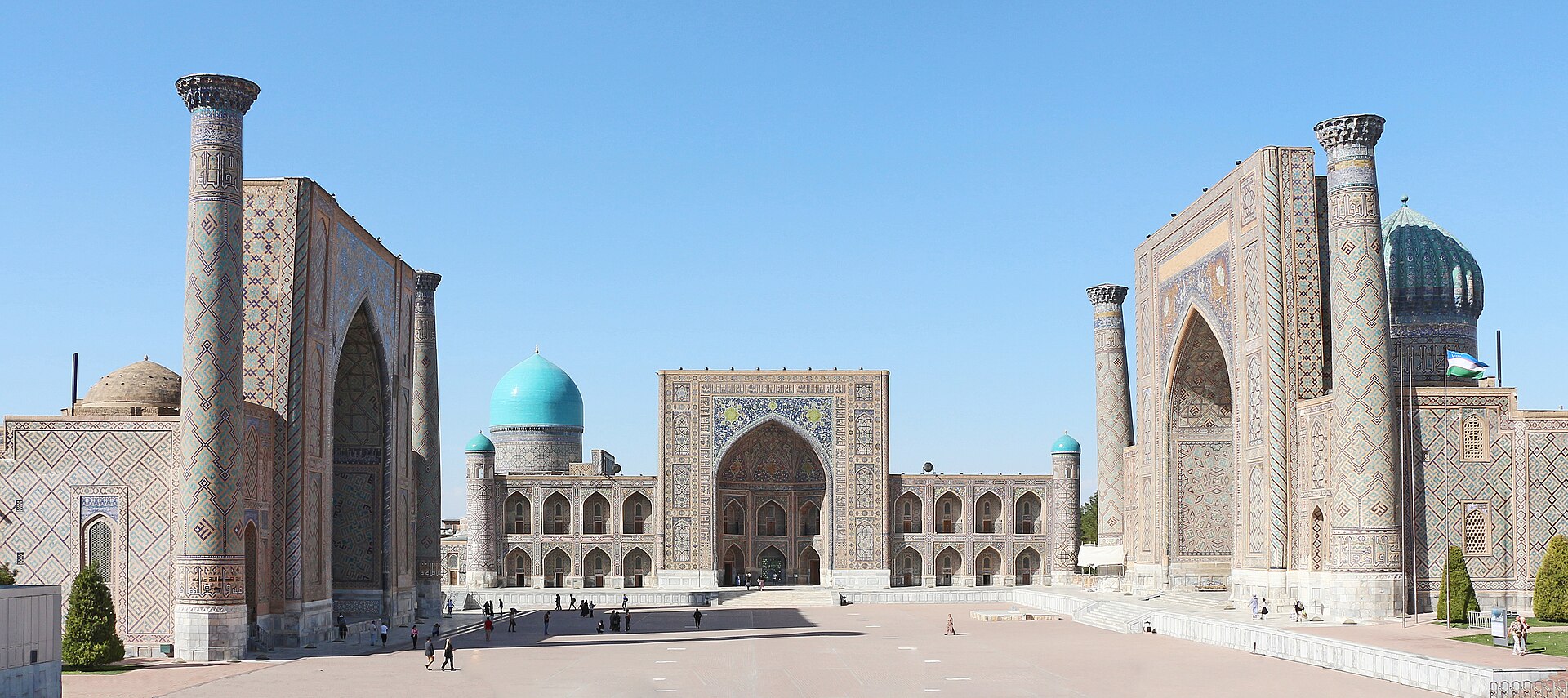
Three madrasas on three sides of one square, two of them deliberately mirrored and the third built two centuries later to close the gap.
Opens at 08:00. Before 10:00 you can have the madrasa courtyards to yourself; the square is fenced off in the evening for the sound-and-light show.
11:30Bibi-Khanym Mosque
Timur built it too big and too fast and it began shedding bricks in his own lifetime — the overreach is the interesting part, not the restoration.
18:00Gur-e-Amir
Timur's tomb, and the fluted dome his descendants copied all the way to Delhi and Agra — Mughal architecture starts in this room.
The gilded interior is small and reads far better under the evening lighting than in flat daylight.
- Day 3
Blue tile and a marble arc
An early hour in the necropolis while the light is low, then the observatory that made Samarkand matter to people who never cared about Timur.
07:30Shah-i-Zinda
Eleven mausoleums along a lane forty metres long, where the blue changes character every few paces — the best tilework in Central Asia, and it fits in one photograph.
Opens at 07:00. Locals count the entrance steps going up and again coming down; matching totals is said to be a good sign.
10:30Ulugh Beg Observatory
The buried arc of a forty-metre marble sextant that measured the length of the year to within a minute in the 1420s, three centuries before anyone in Europe managed it.
- Day 4
Bukhara's centre
The train gets in around midday, which leaves the afternoon for the minaret Genghis Khan refused to knock down and the evening for the pool everyone sits round.
16:00Po-i-Kalyan
Genghis Khan levelled the city and spared this minaret; every one of its brick bands is a different pattern and none of them repeat.
The mosque courtyard has no shade at all. Come late in the afternoon and stay for the minaret lighting.
18:30Lyab-i Hauz
The last of the dozens of public pools that once gave Bukhara both its water and its cholera, and still the place the town itself sits in the evening.
- Day 5
Ark and Samanids
The emir's fortress in the morning, then the oldest building of the whole week, ten minutes' walk west.
09:00Ark of Bukhara
You climb the same ramp the emir's prisoners were marched down onto the execution square outside, and the Great Game gets uncomfortably concrete.
Much of the interior is ruin and the museums inside are thin; the ramp, the walls and the view off the top are what you came for.
11:30Samanid Mausoleum
Tenth-century, pre-Islamic geometry worked entirely in baked brick, and it survived only because centuries of silt buried it — the oldest thing on this trip.
The brickwork throws its best shadows in the morning and goes flat and dull at noon.
- Day 6
Inside the walls
Khiva is one walled town you can cross in ten minutes, so the afternoon of arrival is enough for the two buildings inside the west gate.
16:00Kalta Minor Minaret
Abandoned at a third of its planned height when the khan died — a fat turquoise stump that is the first thing you see through the west gate and unlike anything else in the country.
17:00Juma Mosque
213 carved wooden columns in a dim flat-roofed hall with no arch and no dome — a completely different architecture from everything else this week, and the coolest room in Khiva.
- Day 7
Khiva from the top
Up the minaret before anyone else is out, then the khan's own citadel while the light is still coming across the mud brick.
07:00Islam Khoja Minaret
The only view that puts the whole walled town in one frame, and at seven in the morning you will have the top platform to yourself.
118 steps, unlit and very narrow, with two-way traffic on the same staircase later in the day. Take a torch and skip it if tight spaces bother you.
09:00Kunya Ark
The khan's private citadel, with a blue-tiled summer mosque and a watchtower over the west wall — the last good look at Khiva before the drive to Urgench.
The watchtower is a separate small ticket at the base of the steps and worth it.
Questions
- How long is the Samarkand and Bukhara itinerary?
- The Samarkand and Bukhara itinerary runs 7 days and covers 15 stops across Tashkent, Samarkand, Bukhara, Khiva.
- When is the best time to do the Samarkand and Bukhara itinerary?
- Apr, May, Sep, Oct is the best window for the Samarkand and Bukhara itinerary.
- What happens on day one of the Samarkand and Bukhara itinerary?
- Day one is tashkent, briefly: One market and one square is the right amount of Tashkent — enough to understand why the rest of the trip looks nothing like it.
Sources
Save this itinerary to CarryOn and it becomes a real trip — every stop on your timeline, with entry requirements checked against your passport and the whole thing editable.
Save this as a tripCurated by CarryOn