Seville, Córdoba and Granada
Three Andalusian cities in the order Al-Andalus built them, and the order the heat allows.
City Classic · 7 days · Mar, Apr, May, Oct
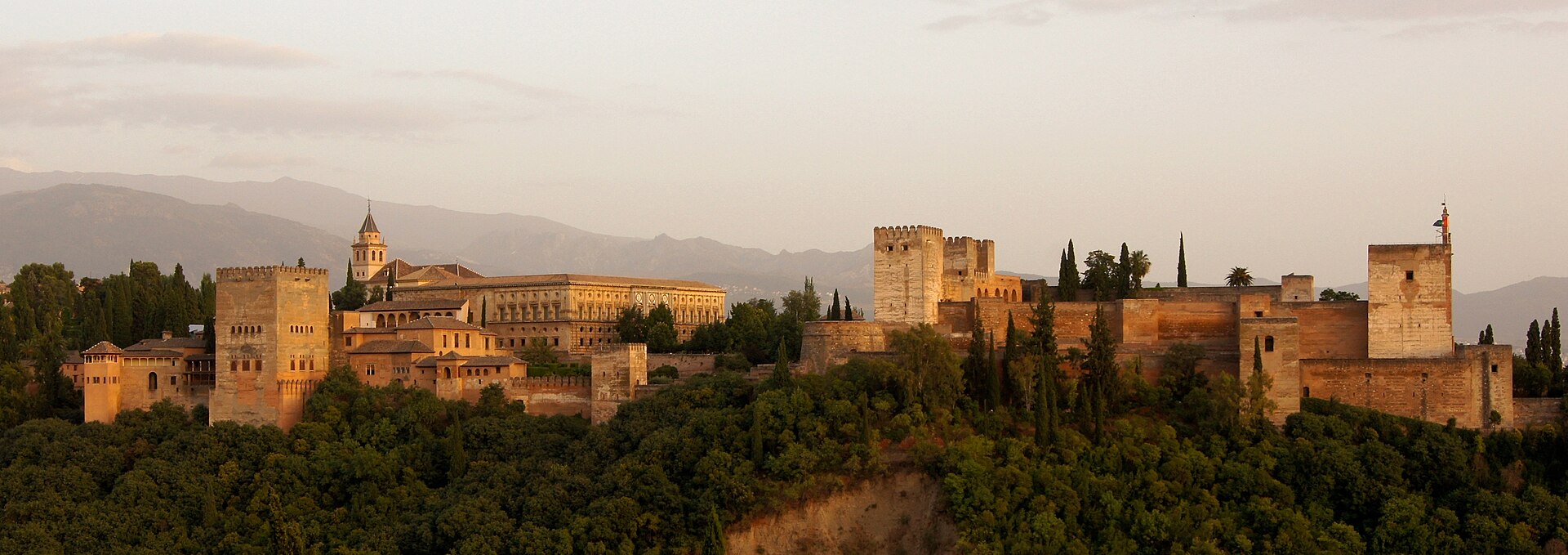
Most itineraries run Granada to Córdoba to Seville, because that is the direction the AVE line arrives from Madrid. Going the other way is better: Seville's Real Alcázar is Mudéjar work made by Granadan craftsmen, so seeing it first gives you the vocabulary to read the Alhambra properly at the end rather than the other way round. It also puts the Albaicín climb on your last evening instead of your first jet-lagged one, and keeps the two long, hot, outdoor sites — Medina Azahara and the Generalife — on mornings.
Day by day
- Day 1
Seville: the Alcázar first
The Mudéjar palace at opening, then a long gap through the worst of the heat before the Plaza de España at dusk.
09:30Real Alcázar de Sevilla
Still a working royal residence, and the palace Pedro I built with craftsmen sent from Granada is the direct reference for everything you will see at the Alhambra on day six.
The Cuarto Real Alto upper apartments are a separate timed ticket sold on the day at the site, and they go by mid-morning.
18:30Plaza de España
Built for the 1929 Ibero-American Exposition and only worth it in the last hour of light, when the forty-eight tiled province alcoves stop being a photo queue.
The rowing boats on the canal stop hiring roughly an hour before sunset.
- Day 2
The cathedral and the rooftop city
The largest Gothic church in the world by volume in the morning, and the newest structure in the old town after dark.
10:00Catedral de Sevilla and the Giralda
The Giralda has no stairs at all — thirty-four ramps built so a muezzin could ride a horse to the top, and the only comfortable tower climb in Andalusia.
Closed to visitors on Sunday mornings for services. The rooftop tour is a separate booking and typically sells out weeks ahead.
20:30Setas de Sevilla
Six timber parasols over a Roman excavation, and the walkway on top is the only high, level, late-opening view of Seville's rooftops.
The ticket includes the Roman antiquarium in the basement, which most people skip and which explains why the square sat empty for a decade.
- Day 3
Palace houses and the river's other bank
A ducal palace nobody queues for, then lunch across the river in the potters' quarter.
10:00Casa de Pilatos
A 16th-century ducal palace where Mudéjar plasterwork and a Roman statue collection share the same courtyard, holding a fraction of the cathedral's crowd two streets away.
The upper floor is guided-only at set times and is where the Medinaceli family still keep the paintings.
13:00Mercado de Triana
The market was built directly over the Castillo de San Jorge, headquarters of the Spanish Inquisition — the fish counters sit on top of the cells, and you can go down and see them.
Trades hardest before 14:00. The ceramic workshops on Calle Antillano Campos are five minutes further in.
- Day 4
Córdoba: the Mezquita at opening
The mosque-cathedral in its early quiet hour, then the fortress gardens next door.
08:45Mezquita-Catedral de Córdoba
Eight hundred columns of recycled Roman and Visigothic stone with a cathedral dropped through the middle of them, and the early hour is the only time the space is quiet enough to hear.
There is an early free-entry window on weekday mornings. It cannot be booked and the queue forms in the Patio de los Naranjos, so arrive before the gate opens.
11:30Alcázar de los Reyes Cristianos
The terraced water gardens are the reason to come — the Catholic Monarchs ran the Granada campaign from here, and Columbus made his case in this courtyard in 1486.
The tower stairs are narrow and one-way. In summer the gardens are floodlit at night on a separate evening ticket.
- Day 5
The caliph's ruined city
A vanished capital in the morning heat, and twelve courtyards in one house when the day cools.
09:30Medina Azahara
A whole caliphal capital founded in 936, sacked within seventy years and lost until 1911 — and you descend through it in the order the court itself did, from the caliph's hall downwards.
Cars must park at the museum and take the shuttle bus; there is no walking or driving access to the ruins from the road.
17:30Palacio de Viana
Twelve courtyards inside a single house, each planted to a different century — the Córdoba patio tradition without the crush of the May festival.
The patios-only ticket costs roughly half the full house tour and is the better buy when it is hot.
- Day 6
Granada: the Nasrid palaces
The half-hour that the whole trip has been building towards, then the summer gardens above it.
08:30Nasrid Palaces, Alhambra
The Court of the Lions is a materially different room with twenty people in it than with two hundred, and the first slot of the day is the only reliable way to get the former.
Your Alhambra ticket carries a fixed half-hour entry window for the Nasrid Palaces alone. Miss it and it is gone — the rest of the site stays valid, but the palaces do not.
12:00Generalife
The Nasrid summer estate, and the one part of the complex where you see what Moorish gardening actually was rather than what the nineteenth century decided it should look like.
Entry is at the far upper end of the site, so do the Generalife last and leave down the Cuesta del Rey Chico, which drops you straight into the Albaicín.
- Day 7
The Catholic Monarchs and the Albaicín
The tombs that ended Al-Andalus in the morning, and the view back at it in the last light.
10:30Capilla Real de Granada
Isabella and Ferdinand lie in a plain lead box in the crypt directly beneath their own marble effigies, and the gap between the two is the entire point of the building.
No photography at all inside, strictly enforced. The sacristy holds Isabella's personal collection of Flemish paintings.
20:00Mirador de San Nicolás
The classic Alhambra view, and better saved for the last evening than spent on the first — the walls hold their colour for about twenty minutes, then the Sierra Nevada behind goes pink.
It fills up an hour before sunset. The Mirador de San Miguel Alto, twenty minutes further uphill, has the same view with a tenth of the people.
Questions
- How long is the Seville, Córdoba and Granada itinerary?
- The Seville, Córdoba and Granada itinerary runs 7 days and covers 14 stops across Seville, Córdoba, Granada.
- When is the best time to do the Seville, Córdoba and Granada itinerary?
- Mar, Apr, May, Oct is the best window for the Seville, Córdoba and Granada itinerary.
- What happens on day one of the Seville, Córdoba and Granada itinerary?
- Day one is seville: the alcázar first: The Mudéjar palace at opening, then a long gap through the worst of the heat before the Plaza de España at dusk.
Sources
Save this itinerary to CarryOn and it becomes a real trip — every stop on your timeline, with entry requirements checked against your passport and the whole thing editable.
Save this as a tripCurated by CarryOn